
Sumo matches are fast, intense, and often decided in just a few seconds. Sumo wrestlers (known as rikishi) don’t just push and shove – they execute well-defined moves, each with a name, history, and purpose.
There are 82 officially recognised winning techniques (kimarite) in sumo, but just a handful of them decide most matches. I analysed 15,333 bouts across the careers of the ranked Makuuchi wrestlers (leading into the January 2025 Basho). I used results from the website Sumo DB, which has a massive amount of sumo-related data. The results were staggering – just five techniques account for nearly 70% of all wins.
Click here to check out and purchase our 70-page First-Timers Guide to Watching a Sumo Tournament – everything you need to know to plan your day and make the most of your sumo tournament experience!
But sumo isn’t just about the most common moves. In this guide, you’ll learn about:
- The two main sumo fighting styles.
- The five fundamental sumo movements.
- The five moves that win nearly 70% of matches.
- Rare and bizarre ways a wrestler can lose by mistake (hiwaza).
- Hansoku (disqualification) – from illegal moves to one of sumo’s most embarrassing ways to lose.
- Spectacular and brutal sumo techniques.
Whether you’re planning to watch sumo in Japan or following tournaments from home, this guide will help you recognise the moments that define every match.
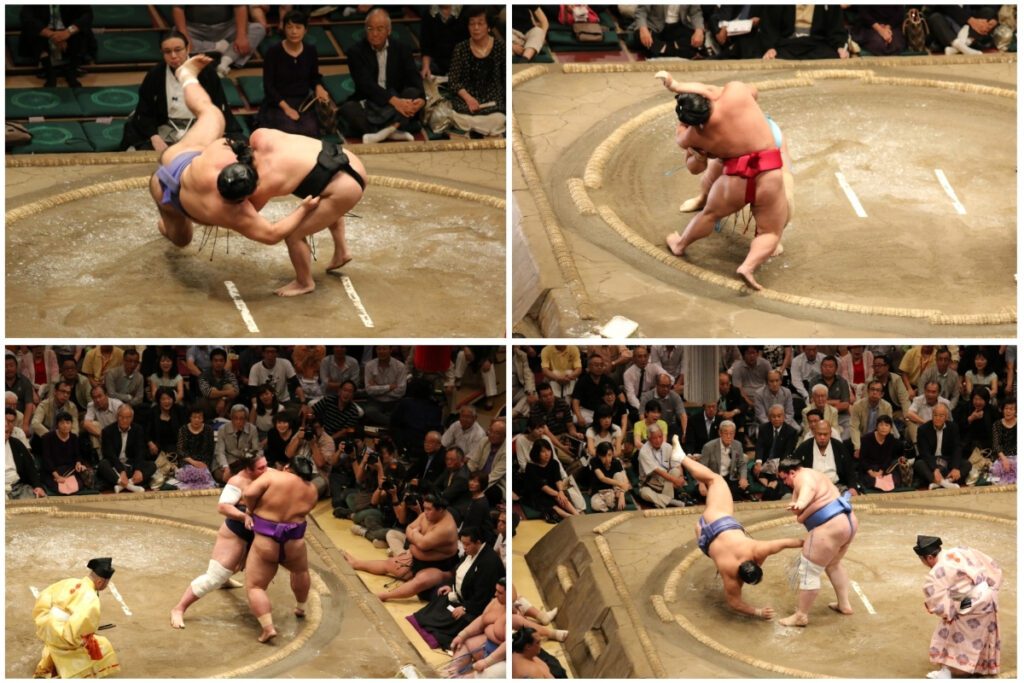
Sumo’s Two Main Fighting Styles
While sumo might seem like a straightforward contest of strength, wrestlers approach matches with distinct strategies. Some prefer to keep their opponents at a distance with powerful thrusts, while others aim to grapple and control the bout with belt grips.
These two broad approaches – oshi-zumo (pushing/thrusting) and yotsu-zumo (grappling) – shape a wrestler’s style, though most incorporate techniques from both depending on their opponent and the situation.
Oshi-zumo – The Power of Pushing and Thrusting
Oshi-zumo literally means ‘pushing’ sumo. It’s a style of sumo wrestling based around pushing (oshi) and thrusting (tsuki).
Wrestlers who favour this style rely on relentless forward pressure to keep opponents at bay. Their goal? They overwhelm and force their rival out before they can secure a belt grip.
This high-impact style favours speed and aggression, allowing wrestlers to dominate early and finish bouts fast. But there’s a risk—one misstep or loss of balance can leave them vulnerable to counterattacks or a sudden grip change.
A prime example of this style is Daieishō, who uses powerful techniques like oshidashi and tsukiotoshi to bulldoze opponents before they can react.
Aoiyama, a veteran oshi-zumo wrestler, built his career around powerful oshi-zumo techniques, particularly hatakikomi (slap down), which is his most frequently used winning move, as seen below in his victory on Day 8 of Aki Basho 2015 in Tokyo.
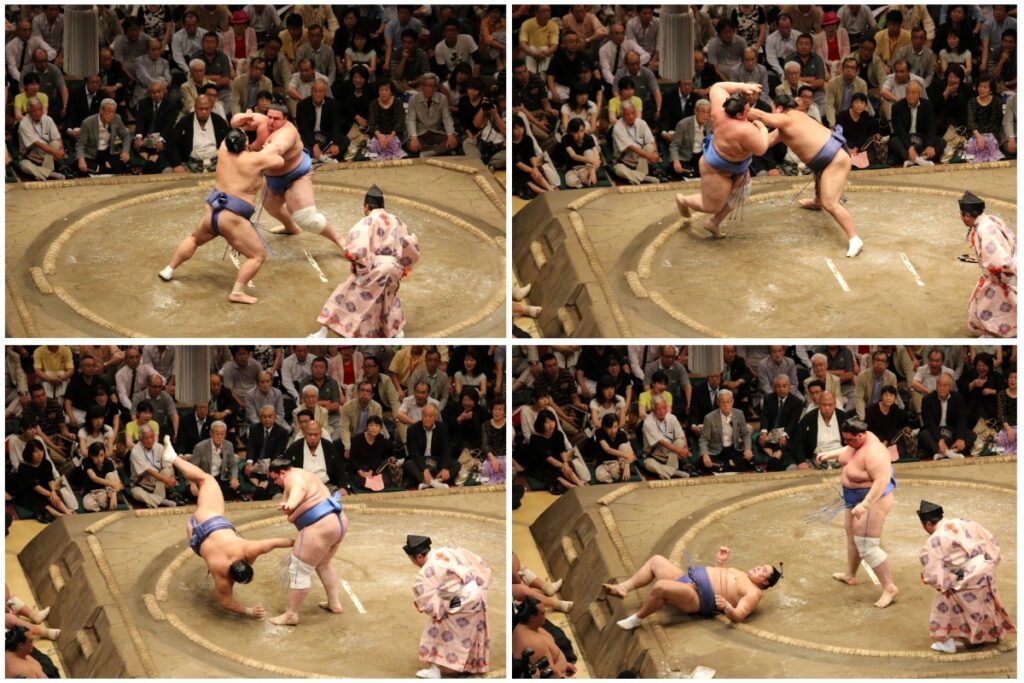
Wins with hatakikomi. Ranked as Maegashira 1 for this tournament.
Oshi-zumo is all about staying in control and keeping opponents on the defensive – because once a grappler gets a hold, the momentum can shift quickly.
Yotsu-zumo – The Art of Grappling and Control
Yotsu-zumo wrestlers thrive in close combat, using grips, leverage, and positioning to control the match.
Rather than relying on sheer force, they excel in balance-breaking techniques, throws, and methodical force-outs, wearing down opponents over time. Closing the distance is crucial; if they fail to do so, they can be overpowered by fast, aggressive attacks.
Terunofuji (retired January 2025) dominated with his powerful inside game, mixing force-outs, throws, and armlocks to control opponents. He rose to the highest rank of Yokozuna and won ten championships. His kotenage (armlock throw) was among his most effective techniques, as seen in his Aki Basho 2015 victory.

Wins with kotenage. He had only just been promoted to Ozeki in the July 2015 Nagoya Basho.
Tochinoshin (retired May 2023) was a force in yotsu-zumo, known for his yorikiri (frontal force-outs) as seen in his Day 8, Aki Basho 2015 match (see below). He also used spectacular belt lifts such as tsuridashi. He sometimes hoisted opponents completely off the ground before carrying them out. Tochinoshin rose to the second highest rank (Ozeki).
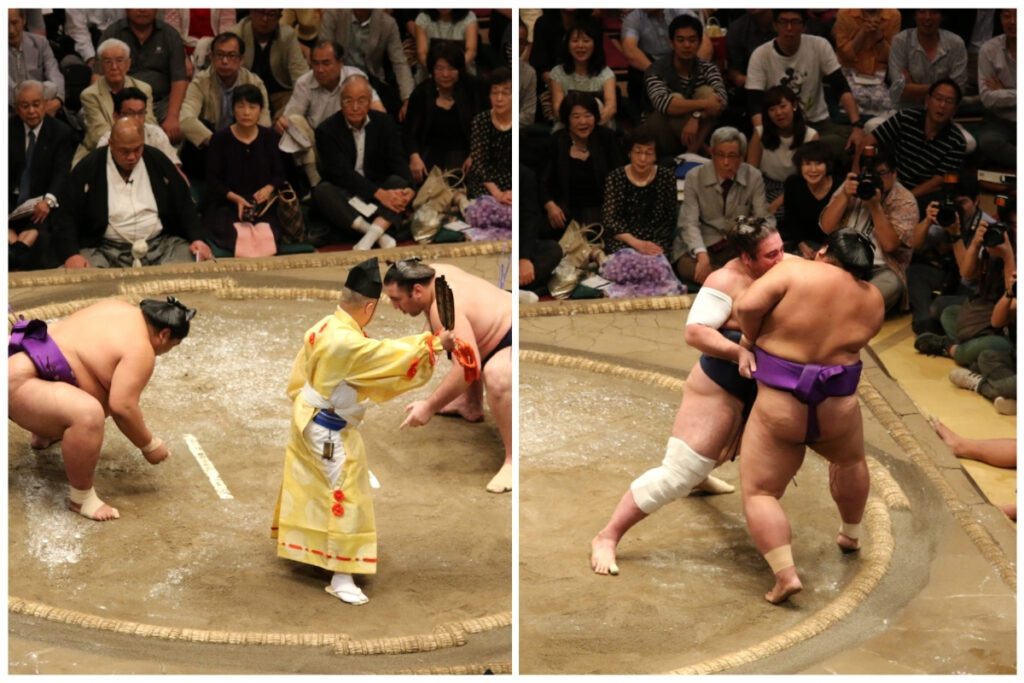
About to win with yorikiri.
Yotsu-zumo wrestlers succeed when they can dictate the match on their terms, using technique and strength to outmaneuver their opponent rather than engaging in an all-out pushing battle.
A Blended Approach
While some wrestlers lean heavily toward one style, modern sumo rewards adaptability. Even oshi-zumo specialists must be able to counter a belt grip, and yotsu-zumo wrestlers must deal with powerful thrusting attacks.
The best rikishi know when to switch tactics, turning sumo into a dynamic battle of skill, power, and strategy rather than a rigid style contest.
Fundamental Sumo Movements
While sumo features a wide range of techniques and variations, most winning sumo techniques stem from five basic movements:
These movements shape a wrestler’s approach in the ring – either oshi-zumo’s explosive strikes and forward pressure or yotsu-zumo’s controlled grappling and leverage-based attacks.
Understanding these core movements makes it easier to see the strategy behind every bout – from quick, forceful push-outs to dramatic, high-impact throws.
Pushing
The most fundamental movement in sumo, pushing involves strong forward pressure to drive an opponent backward. Staying low and compact maximizes power and stability.
It’s the foundation of oshi-zumo, where wrestlers rely on momentum and relentless forward pressure to overpower their opponents.
In the picture below from the September 2015 sumo tournament in Tokyo, Kotoyuki wins by oshitaoshi. He pushes so hard that Daieisho falls backwards to the ground.
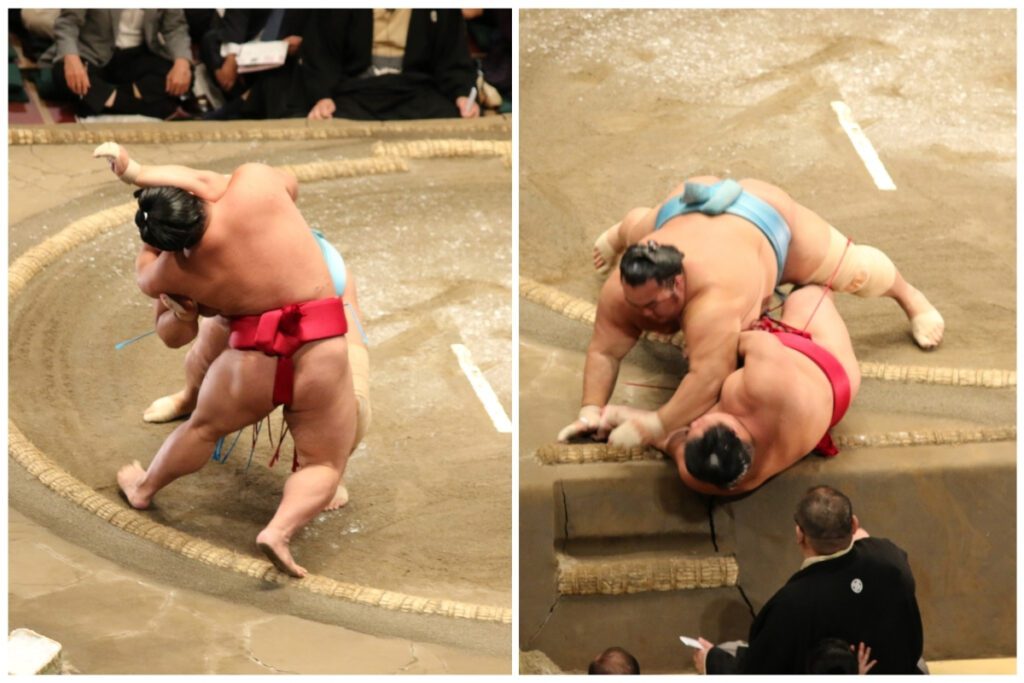
Kotoyuki wins by oshitaoshi (pushing the opponent hard enough that they fall backwards to the ground).
Thrusting
Thrusting is similar to pushing but is executed with rapid, repeated strikes to keep an opponent at a distance. Speed and continuous pressure prevent the opponent from regaining balance.
This technique is key for oshi-zumo specialists, disrupting an opponent’s balance and preventing them from closing the distance. It’s a high-risk, high-reward style—if a wrestler mistimes their thrusts, they can be pulled off balance or countered.
In the image below from the sumo tournament held in Tokyo on September 15, Osunaarashi wins by tsukidashi (a series of palm thrusts) which force Yoshikaze out of the ring.
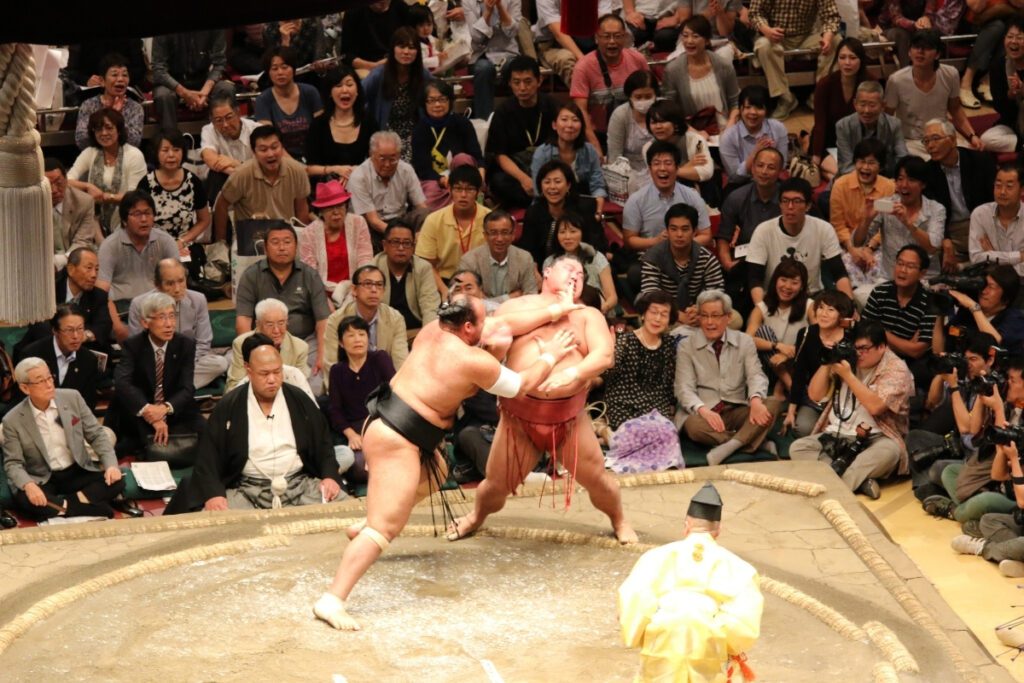
Osunaarashi wins by Tsukidashi (using a series of palm thrust to force the opponent out of the ring).
Forcing Out
Forcing out involves securing a grip on the opponent’s belt or body, maintaining control, and steadily driving them out of the ring.
This movement is the bread and butter of yotsu-zumo. Wrestlers use firm grips on the mawashi (belt) to control their opponent’s centre of gravity and steadily drive them out of the ring.
This movement demands patience, endurance, and strong defensive positioning, making it essential for sumo’s most powerful grapplers.
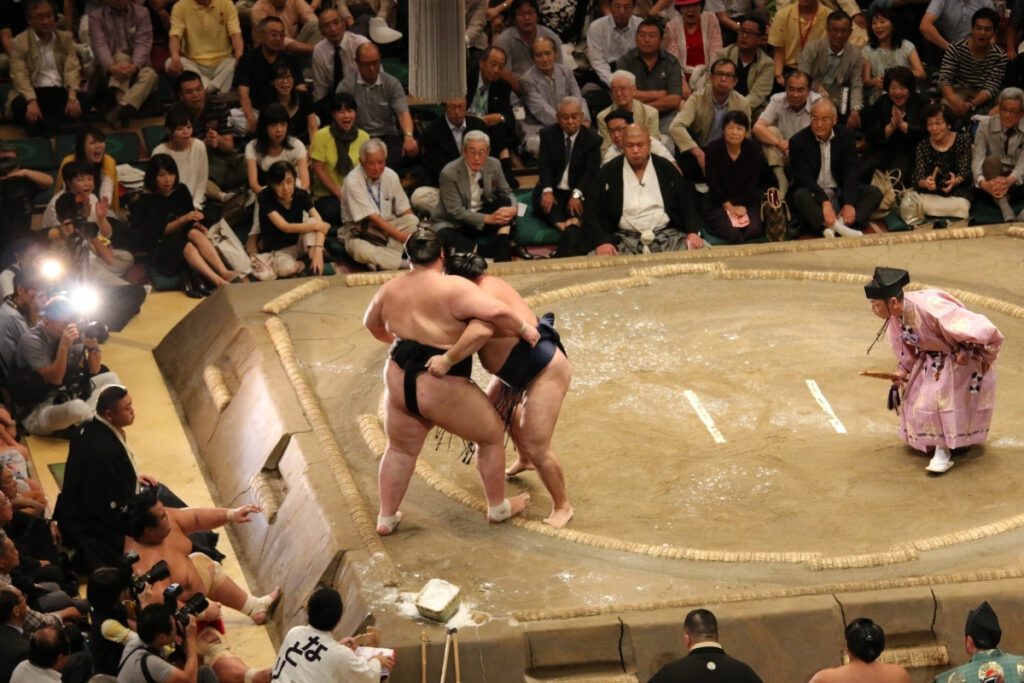
Win by yorikiri (pushing the opponent out of the ring by grabbing the mawashi).
Throwing
Throwing involves a rikishi winning the match by throwing their opponent to the dohyō or out of the ring. After initial pushing attacks, wrestlers often use well-timed throws, leveraging an opponent’s momentum to take them down. Key pivot points include the belt, arms, or legs.
Throws can turn an opponent’s own movement against them, using leverage to send them crashing to the dohyo. Throws allow a wrestler to win even when on the defensive. Yotsu-zumo wrestlers often rely on throws when forcing an opponent out isn’t an option.
An example of throwing is uwatenage (overarm throw) – where a wrestler secures an overarm grip on the mawashi, twisting their opponent sideways or backward for a dramatic finish.
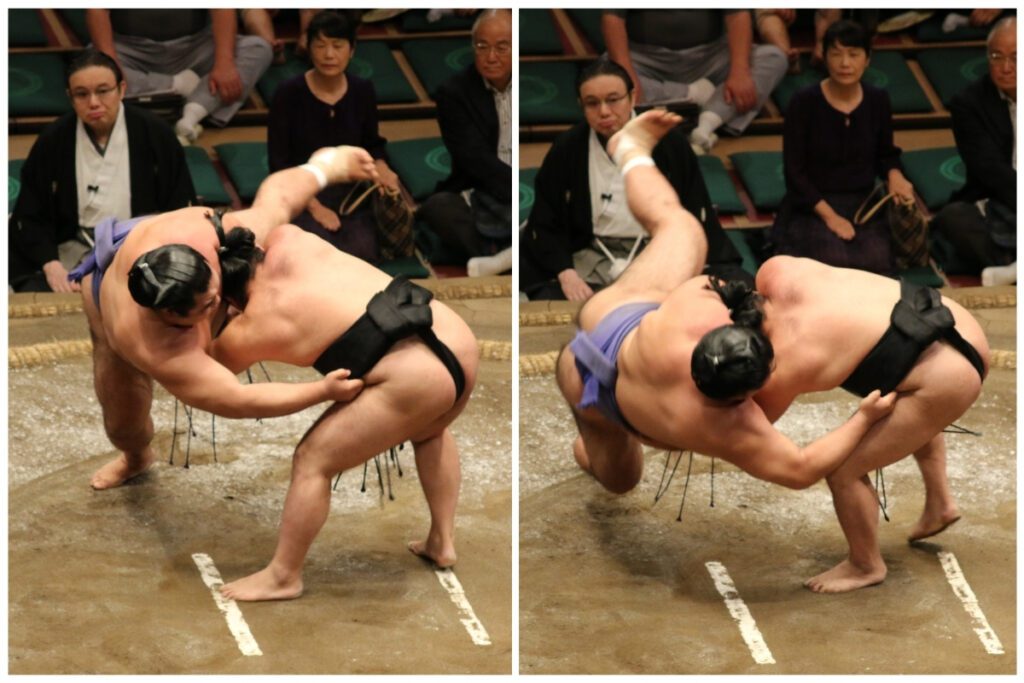
Satoyama wins by shitatehineri (a twisting underarm throw – it involves grabbing the opponent’s mawashi under their arm and pulling them down forward to the ground).
Lifting
Lifting is one of sumo’s rarest and most spectacular techniques—physically hoisting an opponent off the ground and carrying them out of the ring. It requires immense grip strength and lower-body power, making it a signature move of some of sumo’s strongest yotsu-zumo wrestlers.
An example of a lifting technique is tsuridashi (lift out) – in which a wrestler lifts their opponent completely off their feet while gripping the mawashi, carrying them out like a trophy.
The Five Moves That Win Nearly 70% of Matches
Sumo has 82 officially recognised winning techniques (kimarite), but just a handful of dominant moves decide most matches.
I crunched the numbers on over 15,000 bouts, analysing the career wins of Makuuchi division wrestlers leading into the January 2025 Basho. The results? Five techniques alone account for nearly 70% of all victories. The top ten techniques make up just under 85% of all wins (as you you can see in the pie chart below).
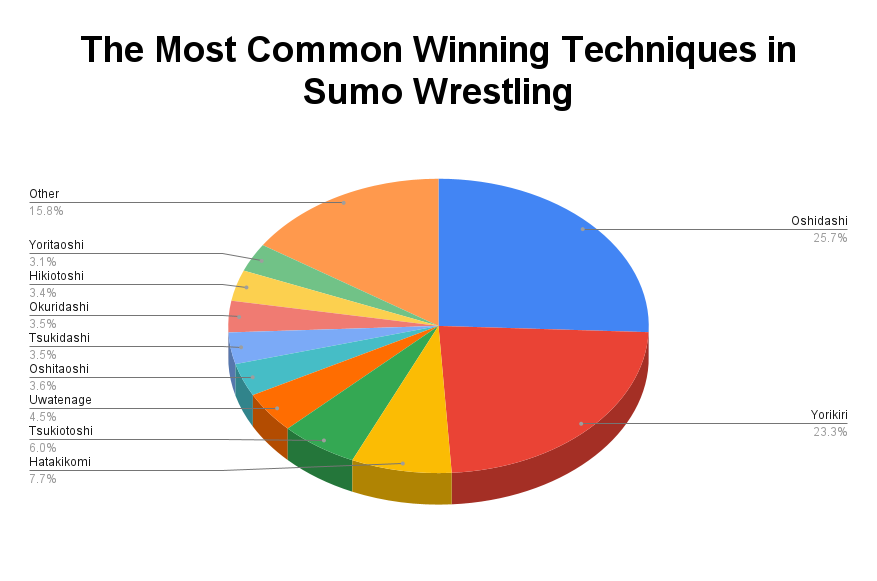
Whether you’re a first-time viewer or a seasoned sumo fan, knowing these key techniques makes every match easier to follow – and far more exciting to watch.
Oshidashi (Frontal Push Out) – Most Common Winning Move
Oshidashi is sumo’s most frequent winning technique, responsible for just under 26% of all victories. It’s the bread and butter of oshi-zumo specialists, who rely on raw force to drive opponents backward without ever grabbing the mawashi (belt).
How it works: A wrestler pushes on the opponent’s chest, throat or underarms, maintaining forward pressure until their opponent is forced out of the ring.
Why it’s effective: Speed, momentum, and sheer physical dominance make it the go-to technique for pushing and thrusting specialists.
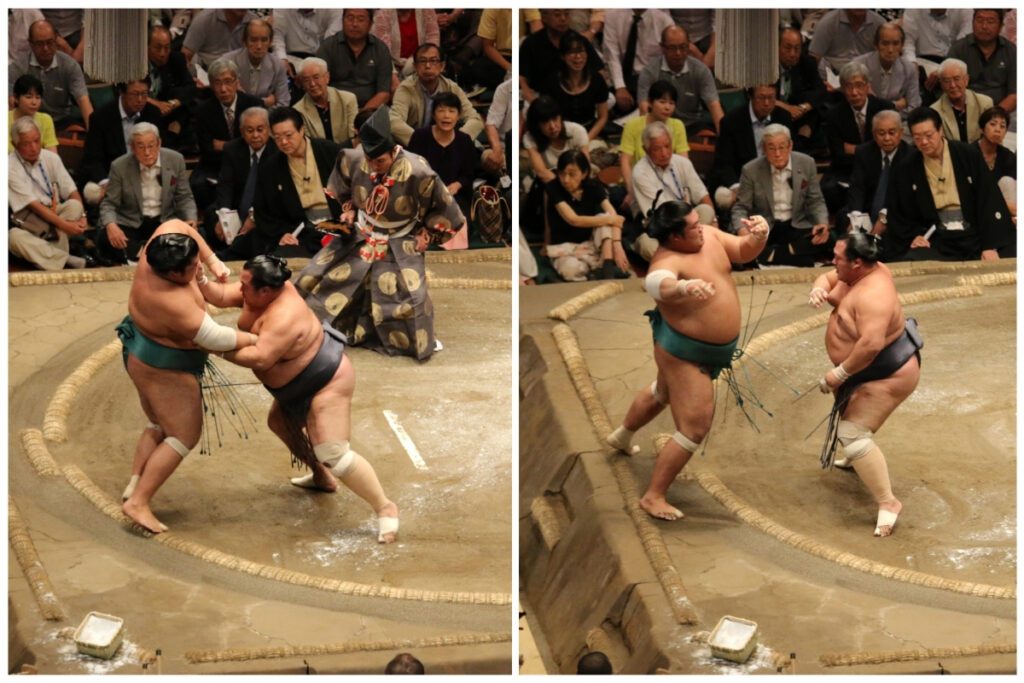
Toyonoshima wins by oshidashi.
Yorikiri (Frontal Force Out) – Belt Control Domination
Yorikiri is the most common winning move for yotsu-zumo wrestlers, used to win 23% of the matches I analysed. Instead of pushing from a distance, this technique is all about close-range control.
How it works: The winning wrestler locks onto their opponent’s mawashi, maintaining constant pressure as they methodically drive them out of the ring.
Why it’s effective: Strength, balance, and endurance are key—yorikiri is a test of raw power and positioning rather than quick bursts of force.
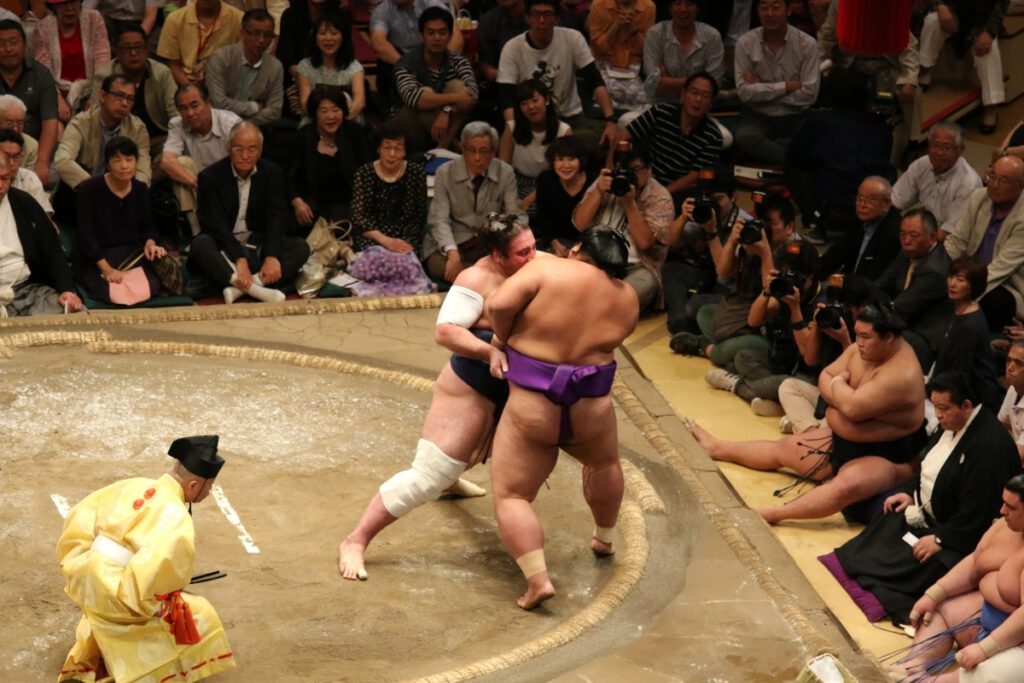
Tochinoshin about to win with yorikiri.
Hatakikomi (Slap Down) – Quick and Sneaky Counterattack
Hatakikomi is sumo’s most effective counter move, used in just under 8% of victories. Instead of overpowering an opponent, it uses their aggression against them.
How it works: A wrestler lures their opponent into an overcommitted charge, then steps to the side and slaps them (on the shoulder or back) down to the dohyo before they can recover.
Why it’s effective: Fast, deceptive, and ruthless, this technique is a favourite of oshi-zumo wrestlers who thrive on aggressive exchanges.

Aminishiki Wins by hatakikomi.
Tsukiotoshi (Thrust Down) – Using Momentum Against the Opponent
Tsukiotoshi is a forceful thrusting technique that turns an opponent’s own movement into a crushing defeat. It was the fourth most common winning technique, responsible for 6% of wins.
How it works: The wrestler pushes the opponent to the ground by a pushing force on the opponent’s upper torso.
Why it’s effective: It’s a power move that keeps opponents at a distance, making it a crucial tool for oshi-zumo wrestlers who don’t want to get locked into a grappling match.
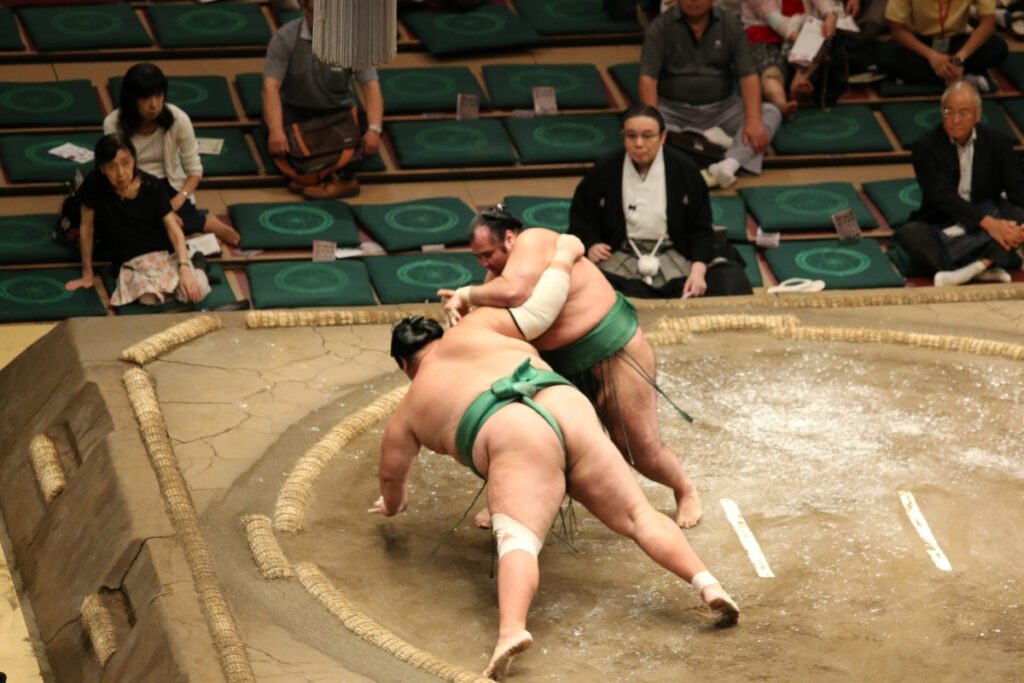
Wakanoshima wins by Tsukiotoshi – Juryo Bout.
Uwatenage (Overarm Throw) – A Powerful, Decisive Throw
Uwatenage is one of the most dramatic throws in sumo, responsible for 4.5% of wins in the analysed matches. It’s a high-risk, high-reward technique that can turn a bout on its head.
How it works: The wrestler secures an overarm grip on the mawashi, then rotates their hips and upper body to throw their opponent.
Why it’s effective: Unlike techniques that rely on pushing an opponent out, uwatenage allows a wrestler to win even while being forced backward, making it a critical tool for yotsu-zumo wrestlers.
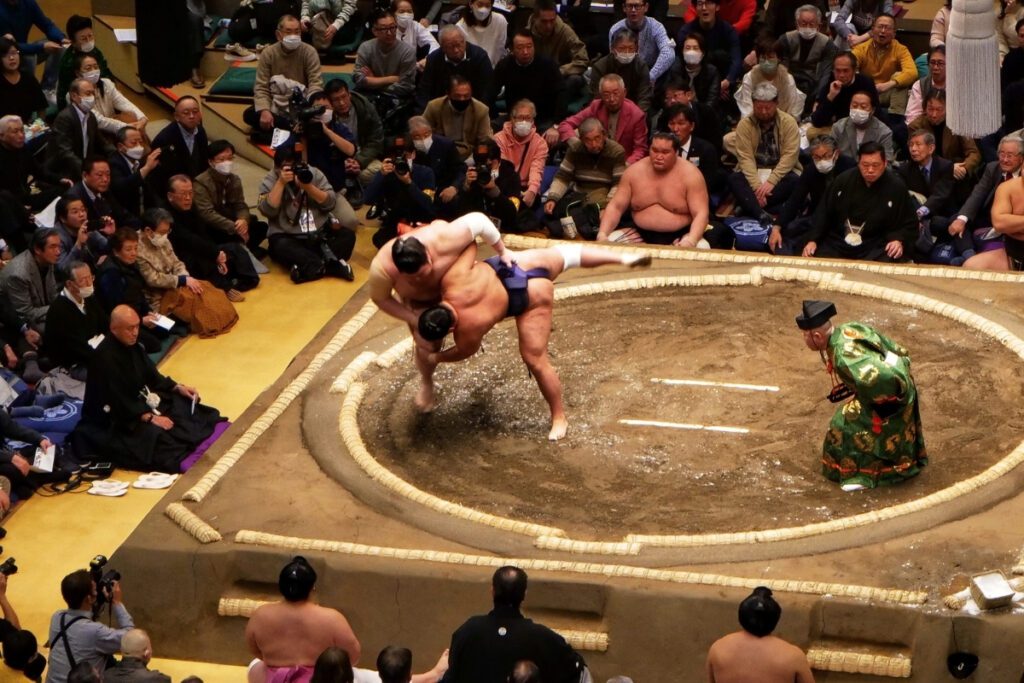
Atamifuji attempting to win by uwatenage. After this Hoshuryu recovers and wins just after this by yorikiri.
Five Ways to Lose in Sumo
Not every sumo match ends with a dramatic push-out or a perfectly executed throw. Sometimes, a wrestler loses without their opponent needing to land a decisive technique.
These losses fall under hiwaza – non-techniques where a wrestler defeats themselves by stepping out, slipping, or collapsing.
While rare at the highest levels, these unforced errors can instantly change the outcome of a match, proving that in sumo, balance and awareness are just as crucial as power and skill.
Isamiashi (Accidental Step-Out) – Defeat by Your Own Footwork
In sumo, stepping out of the dohyo (ring) means instant defeat. Isamiashi happens when a wrestler steps out without being forced, often while attacking or trying to regain balance.
Rarity: Just 16 out of 15,000+ bouts ended this way.
How it happens example: A wrestler lunges forward to push their opponent out, but their own momentum carries them over the straw bales (tawara) first.
Why it’s frustrating: The losing wrestler may have been on the verge of victory only to lose due to one misplaced step.
Tsukihiza (Knee Touching the Ground) – A Costly Misstep
Tsukihiza occurs when a wrestler loses control and drops to one knee, immediately ending the match. It’s often the result of buckling under pressure, an awkward stance, or a last-second loss of footing.
Rarity: Seen in just 12 bouts of the matches analysed.
How it happens example: A wrestler braces against a shove but suddenly buckles, and their knee touches the dohyo – match over.
Why it’s frustrating: It’s not a throw, a push, or a strike – just a momentary collapse that costs the match.
Tsukite (Hand Touching the Ground) – A Loss Without a Fall
In sumo, only the soles of a wrestler’s feet should touch the ground. If a wrestler accidentally plants a hand, they lose instantly.
Rarity: Occurred in just eight bouts analysed.
How it happens example: A wrestler stumbles while dodging an opponent’s attack and instinctively puts a hand down to catch themselves.
Why it’s frustrating: Sometimes, it’s just a fingertip touching the dohyo that determines the outcome.
Koshikudake (Unintentional Collapse) – Falling Over Without Contact
One of the most embarrassing ways to lose is koshikudake, which occurs when wrestlers collapse without their opponent touching them.
Rarity: Just eight matches ended this way in the analysed bouts.
How it happens example: A wrestler overcommits to a charge, loses footing, and falls backward on their own.
Why it’s frustrating: This loss is a reminder that stability and stance matter as much as strength.
Fumidashi (Sideways/Backward Step-Out) – Slipping Near the Edge
Like isamiashi, but instead of stepping forward and out of the ring, fumidashi happens when a wrestler slips sideways or backward over the tawara.
Rarity: Just six bouts in the data ended this way.
How it happens example: A wrestler pivots near the edge, loses footing, and slips out backward—without their opponent even touching them.
Why it’s frustrating: Sweat, loose sand on the dohyo, or a last-second feint can turn an advantage into instant defeat.
Injury-Related Loss (Not an Official Hiwaza, But Still a Loss)
While not an official hiwaza, self-inflicted injuries mid-bout can also lead to a loss. If a wrestler collapses due to injury, cannot continue, or falls unconscious, the match is awarded to their opponent.
Example: Daisuke (2025) suffered an ankle injury mid-match and could not continue—resulting in an instant loss.
Hansoku (Disqualification) – Breaking the Rules
Disqualifications in sumo are exceptionally rare. However, there are a few ways a wrestler can lose by disqualification (hansoku). This can happen either by committing an illegal move (kinjite) or violating a rule that results in an automatic forfeit.
While these cases are uncommon, when they do happen, they often create shock, controversy, and sometimes even historical firsts.
Kinjite (Forbidden Techniques) – Moves That Result in Instant Disqualification
Sumo may be a brutal, full-contact sport, but it has strict rules about what kind of contact is allowed.
Certain moves are forbidden (kinjite) because they pose a serious risk of injury or violate the traditional spirit of sumo. If a wrestler uses one of these banned moves – even by accident – they are immediately disqualified (hansoku), and their opponent wins.
Here are the most notable kinjite violations:
Hair-Pulling
A sumo wrestler’s chonmage (topknot) is a symbol of their rank and tradition, and grabbing it is strictly forbidden.
Why it’s banned: Unlike the mawashi (belt), the chonmage is not meant to be used as leverage—pulling it is considered both unfair and disrespectful.
Example: Asashoryu (2000) was disqualified for hair-pulling, marking one of the rare instances where a dominant Yokozuna lost this way.
Strict enforcement: Even unintentional contact is penalised—if a wrestler grabs and pulls hair, they lose immediately.
Punching
Sumo allows slaps (harite) and open-handed thrusts (tsuppari), but closed-fist punches are illegal.
Why it’s banned: Unlike boxing or MMA, sumo emphasises technique over brute force—closed fists contradict this philosophy.
Grey areas: Some wrestlers push the limits with hard slaps that border on punches—but if a fist is fully closed, it’s an automatic disqualification.
Eye-Gouging
While unintentional eye contact happens in the heat of battle, deliberately poking, gouging, or pressing an opponent’s eyes is strictly forbidden.
Why it’s banned: Sumo has no protective gear, and an eye injury could permanently end a wrestler’s career.
Strict enforcement: Wrestlers are trained to keep their hands away from the face – even an accidental eye poke can lead to an official warning.
Groin-Grabbing
Sumo wrestlers grapple intensely, but grabbing an opponent’s groin—deliberately or accidentally—is an instant loss.
Why it’s banned: This rule preserves sumo’s dignity – the sport is about balance, power, and technique, not dirty tactics.
Rare but real: While extremely uncommon, there have been disqualifications in lower divisions for this violation.
Additional Kinjite: Choking, Kicking, and Illegal Mawashi Grips
- Choking – Strangling an opponent’s neck or throat is illegal. While pushing against the throat (nodowa) is allowed, any grip or sustained pressure that cuts off breathing is an instant disqualification.
- Kicking the knee joints – While sweeping the legs is legal, kicking the knee joints is banned to prevent career-ending ligament injuries.
- Grabbing the mawashi in an illegal area – Wrestlers must grip the front, sides, or back of the mawashi. Grabbing the part covering the groin or tucking fingers inside the mawashi is illegal and results in disqualification.
Other Disqualifications (Non-Kinjite Hansoku)
Not all disqualifications in sumo involve illegal techniques – some happen due to unexpected circumstances or breaches of sumo etiquette. While rare, these non-kinjite hansoku result in an instant loss, just like forbidden moves.
Mawashi Coming Undone – The Most Embarrassing Disqualification
Sumo’s most fundamental uniform is the mawashi (belt), which must remain secure throughout the match. If a wrestler’s mawashi comes completely loose or falls off, they are immediately disqualified – a rule that maintains the sport’s dignity and tradition.
It’s officially recognised by the Guinness Book of World Records as the rarest way to lose in sumo.
The most infamous case happened in May 2000, when sandanme-ranked wrestler Asanokiri Mitsuru was disqualified mid-match after his mawashi came undone, leading to his immediate forfeit.
It was the first time this happened in 83 years. The previous recorded incident occurred in May 1917, when jūryō wrestler Otokojima suffered the same fate against makushita-ranked Tomonoyama.
While incredibly rare, this rule serves as a reminder that even sumo’s most powerful wrestlers are not immune to unexpected moments of embarrassment.
Not Showing Up (Fusenpai) – A Walkover Loss
Sumo tournaments are physically gruelling, and injuries are common. If a wrestler cannot compete in a scheduled bout, they forfeit the match – this is known as fusenpai (default loss).
It’s more common than you’d think: 154 out of 15,333 bouts in the data I analysed ended this way. It often happens because wrestlers who sustain injuries mid-tournament will withdraw rather than risk further damage.
Spectacular and Brutal Sumo Techniques
Sumo isn’t just about force-outs and slap-downs—sometimes, a match ends in a way that defies expectations and electrifies the crowd. While most bouts are decided by a handful of common techniques, every so often, a wrestler pulls off something spectacular.
While rarely seen, these techniques create some of sumo’s most thrilling and unforgettable moments. Whether it’s a high-impact throw, an improbable escape, or sheer brute strength, these moves keep fans on the edge of their seats.
Here are some of the most crowd-pleasing, brutal, and awe-inspiring sumo techniques.
Izori (Backwards Body Drop) – One of the Rarest Moves in Sumo
Izori is so rare that many sumo fans have never seen it performed live. In this breathtaking technique, a wrestler ducks under their opponent, grabs their legs, and flips them backward onto the dohyo. Instead of pushing forward, the winning wrestler arches backward to execute the move—completely reversing the match.
Why It’s Spectacular: Izori is an incredible reversal, turning what looks like an imminent loss into an improbable victory. The technique requires perfect timing, agility, and flexibility, making executing against larger, more grounded opponents nearly impossible.
Rarity: Since records began, Izori has been used only a handful of times in professional sumo history.
Tsuridashi (Lift Out) – The Ultimate Display of Power
One of the most visually impressive techniques in sumo, tsuridashi occurs when a wrestler physically lifts their opponent off the ground and carries them out of the ring. This feat requires immense strength, balance, and control, as the opponent will be struggling to escape.
Why It’s Spectacular: Seeing a rikishi hoist their opponent into the air like a sack of rice is an astonishing display of raw power. Fans erupt in cheers when a wrestler manages to execute this technique, as it is one of the most dominant ways to win.
Famous Example: Tochinoshin, known for his immense grip strength, regularly used tsuridashi throughout his career, even lifting opponents heavier than himself.
Rarity: While more common than Izori, Tsuridashi is still a rare and impressive feat.
Kakenage (Hooking Inner Thigh Throw) – A Flashy Counter-Move
Kakenage is a bold and acrobatic throw where a wrestler hooks their leg around their opponent’s inner thigh and uses their upper body to twist them onto the ground. This move is often used as a last-second counter when a wrestler is being pushed backward.
Why It’s Spectacular: Kakenage is a high-risk, high-reward technique—it requires explosive lower body strength and perfect positioning. If mistimed, the attacking wrestler risks losing their own balance instead.
Famous Example: While rare in modern sumo, lighter and more agile wrestlers have occasionally pulled off this dramatic move to turn the tide of a match. It was used only thirteen times in the over 15,000 bouts I looked at.
Rarity: Extremely uncommon, but always a crowd favourite when executed.
Amiuchi (Fisherman’s Throw) – Like Casting a Net Over an Opponent
Amiuchi is one of the most unusual winning moves in sumo, resembling the motion of casting a fishing net. The wrestler grabs their opponent by the arm or belt and swings them sideways in a wide, arcing motion, throwing them to the ground.
Why It’s Spectacular: The move looks completely different from standard sumo techniques, making it instantly recognizable. The sweeping motion and unexpected angle of attack make it a visually dramatic finish.
Rarity: One of the rarest throwing techniques, rarely seen at the highest levels.
Ipponzeoi (One-Arm Shoulder Throw) – A Judo-Style Throw in Sumo
Ipponzeoi is one of the most judo-like techniques in sumo, where a wrestler lifts their opponent over their shoulder and flips them onto the ground. This move requires a strong grip, precise timing, and exceptional core strength.
Why It’s Spectacular: This move is rarely attempted because sumo’s centre of gravity is much lower than in judo. However, when executed, it looks like something straight out of a martial arts movie, leaving the crowd stunned.
Famous Example: Ipponzeoi has been attempted occasionally by smaller, more agile wrestlers, but successful executions are incredibly rare. There was only one win by ipponzeoi out of 15,000 bouts.
Brutal Tachi-ai Techniques – The Impact of the Initial Charge
While most winning techniques happen mid-match, some of sumo’s most brutal moments occur right at the tachi-ai—the opening charge. Certain high-impact techniques, while not official kimarite, can immediately shift the course of a match and sometimes lead directly to victory. In rare cases, they can knock out an opponent or cause injury, resulting in a match-ending loss.
Buchikamashi (Head-First Charge) – A Human Wrecking Ball
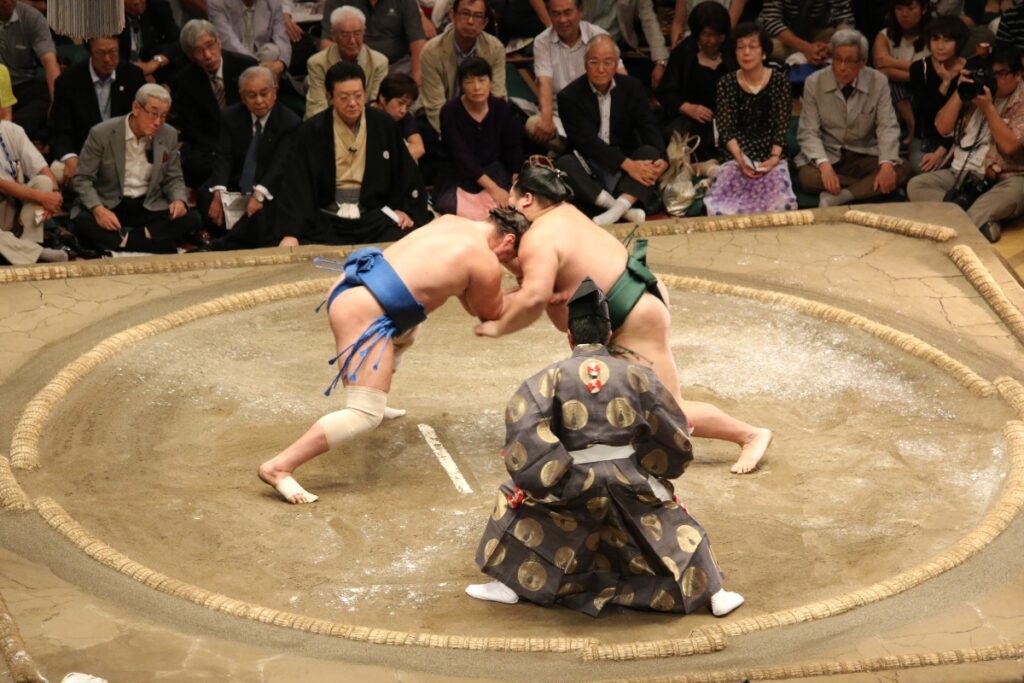
Buchikamashi is an all-in, head-first charge designed to bulldoze the opponent backward before they can react. This technique is often used by power-focused wrestlers who rely on sheer force to gain an early advantage.
Why It’s Brutal: The sheer impact can stagger an opponent instantly, making them easy to finish off. However, if the opponent sidesteps or counters, it can leave the attacker vulnerable.
Kachiage (Forearm Smash) – A Devastating Blow
Kachiage is an upward forearm strike, usually aimed at the opponent’s chin or chest. It is one of the most controversial tachi-ai techniques, as it can be devastating when executed with force.
Why It’s Brutal: A well-placed kachiage can knock an opponent unconscious, leaving them unable to continue. If this happens, the match is ruled a loss for the unconscious wrestler, and the winning technique is determined based on how the match was progressing.
Harite (Open-Handed Slap) – A Thunderous Face Slap
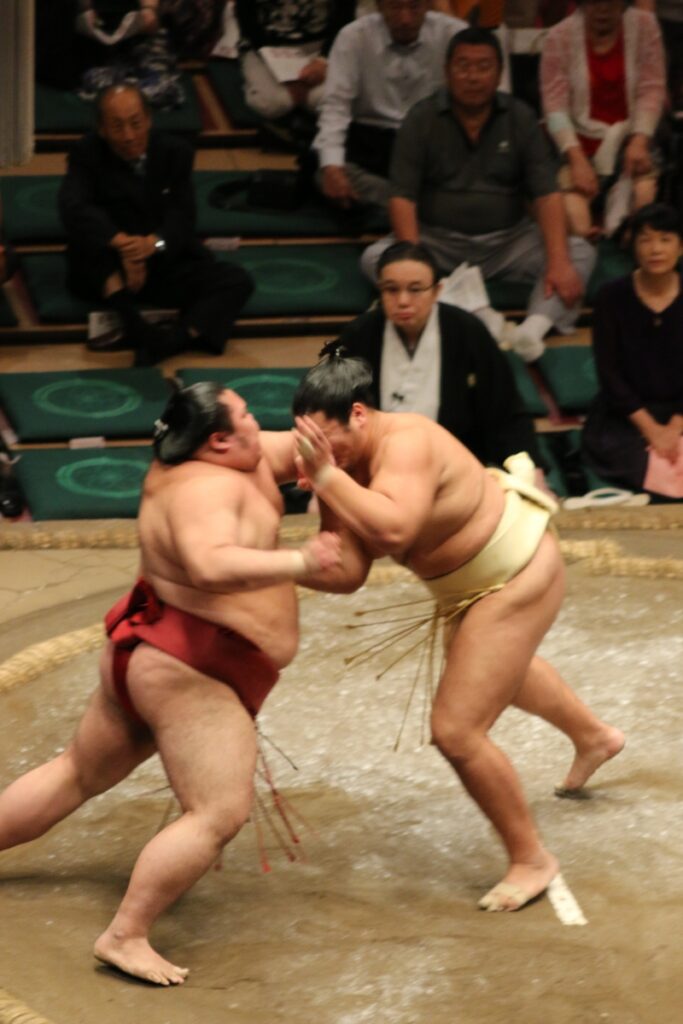
Harite is a powerful open-handed slap delivered straight to an opponent’s face. While legal, it is one of sumo’s most aggressive striking techniques.
Why It’s Brutal: A well-placed harite can disrupt the opponent’s balance or stun them momentarily, making it easier to finish the match.
Nekodamashi (Clap to the Face) – A Deceptive Start
Nekodamashi, meaning “fool-the-cat trick,” involves a wrestler clapping their hands directly in front of their opponent’s face at the tachi-ai, aiming to distract or startle them for even a split second.
Why It’s Spectacular: This move is more about psychological warfare than brute strength. If successful, it can leave the opponent wide open for an attack.
Knockouts & Injuries at the Tachi-ai
If a wrestler is knocked out or injured at the tachi-ai due to a legal technique, the match is ruled based on how it unfolded:
- If they collapse to the ground, it may be ruled koshikudake (unintentional collapse) or another fitting kimarite.
- If they are unable to continue, their opponent is awarded the win.
If the knockout was caused by a forbidden move (kinjite), the attacking wrestler is disqualified (hansoku).
Final Thoughts
Sumo is more than brute strength—it’s a battle of skill, strategy, and split-second decisions. While five core techniques decide nearly 70% of matches, it’s the rare, spectacular moves that leave fans in awe.
From a crushing Oshidashi push-out to a jaw-dropping tsuridashi lift, every match is a clash of power and precision. Some bouts end in seconds, while others turn into a gritty test of endurance. Either way, every move tells a story.
Knowing sumo’s techniques makes every match more exciting – whether you’re ringside in Japan or watching from home. The next time two rikishi step onto the dohyo, you won’t just see a fight – you’ll see a centuries-old sport of skill, strength, and strategy unfold before your eyes.
Make sure to purchase our 70-page First-Timers Guide to Watching a Sumo Tournament. It includes how to plan your tournament day out, as well as information on how to purchase tickets, learn the basics of sumo ranks, understand how tournaments work, and learn about sumo wrestling rules and traditions.
You may also like:
Top Tips for Seeing Sumo at Ryogoku Kokugikan Arena
You Can Watch Sumo Practice in Tokyo – Here’s How
The Fascinating History of Sumo Wrestling

5 Ways to Experience Sumo Wrestling in Tokyo [2026]
How to Book a Sumo Training Experience in Japan for Tourists
6 Sumo Wrestling Restaurants in Japan to Book Now
Join our Japan Travel Facebook Groups

Ready to explore Japan your way? Join our Facebook communities today and start your Japan adventure:
- Overall Japan: insider Japan travel tips
- Family Adventures: kid-friendly adventures in Japan & Tokyo
- Tokyo & Beyond: Discover Tokyo, Mt Fuji & Sumo Experiences
Tony always dreamed of travel but didn’t get started until his mid-20s, when he met Anne and swapped his collection of travel brochures for real adventures.
A qualified elementary school teacher, he joined the blog in 2018 and transitioned to blogging full time in 2023.
Tony particularly enjoys exploring Japan’s street food, sumo tournaments, and hidden neighbourhoods in Tokyo.